Monday, January 7, 2008

Pontochō Alley


Pontochō (先斗町) is a district in Kyoto, Japan, known for geisha and home to many geisha houses and traditional tea houses. Like Gion, Pontochō is famous for the preservation of forms of traditional architecture and entertainment.
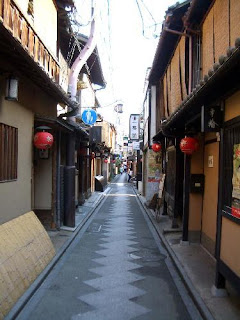
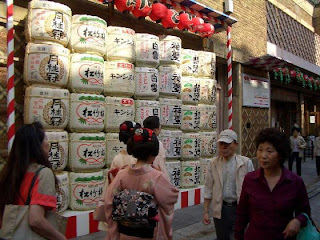
The name Pontochō is said to be a portmanteau of the English word "point" or the Portuguese word "ponto" (also meaning point) and the Japanese word meaning town, street, or road. The district crest is a stylized water plover or chidori.

Pontochō centres around one long, narrow, cobbled alley running from Shijo-dōri to Sanjo-dōri, one block west of the Kamo River (Kamogawa). This is also the traditional location of the start of kabuki, and a statue of Okuni still stands on the opposite side of the river.

Geisha have existed in Pontochō since at least the 1500s, as have other forms of entertainment. Today the area, lit by traditional lanterns at night, contains a mix of very expensive restaurants—often featuring outdoor riverside dining on wooden patios—geisha houses and tea houses, and cheap eateries.


The area is also home to the Pontochō Kaburenjō Theatre at the Sanjo-dōri end of the street. This theatre functions as a practice hall for geisha and twice a year since the 1870s Kyoto geisha perform the Kamogawa Odori—Kamogawa river dancing, a combination of traditional dance, kabuki-like theatre, singing and the playing of traditional instruments—there, offering a rare chance for ordinary people to see performances by real geisha.
Pontochō is also home to the tiny Tanuki ("Badger") Shrine. In 1978 a fire broke out in Pontochō, taking the life of a geisha. where it stopped, a ceramic tanuki was found shattered by the heat. Believing that Mr. Tanuki has sacrificed himself on their behalf, the residents built this little shrine to house his remains. Throw in a coin and record a message imparts such pearls of wisdom as "beware of fire."
Pontochō is also the location of the geisha house where American anthropologist Liza Dalby apprenticed.

Nijo Castle

Nijō Castle (二条城), located in Kyoto, is best known for its unusually ornate interiors and so-called nightingale floors. The floors were designed to make bird-like squeaking sounds when walked upon, a warning of possible intruders.

Karamon Gate This Momoyama-period gate has a Chinese-style gable and gold-plated fixtures.


In 1601, Tokugawa Ieyasu, the founder of Tokugawa Shogunate, ordered all the feudal lords in Western Japan to contribute to the construction of the Nijō Castle. The construction was completed during the reign of Tokugawa Iemitsu in 1626. It was built as the Kyoto residence of the Tokugawa Shoguns.

The central keep or donjon was struck by lightning and burned to the ground in 1750.
In 1788 the Inner Palace was destroyed by a city-wide fire. The site remained empty until 1862.

Entrance to Palace

The Nijō Castle has two concentric rings of fortifications, both consisting of a wall and a wide moat. There is also a much simpler wall surrounding the Ninomaru Palace. The outer wall has three gates while the inner wall has two. In the southwest corner of the inner wall the are the foundations of a five-storey keep, destroyed by a fire in 1750. The inner walls contain the Honmaru Palace with its garden. Between the two main rings of fortifications are located the Ninomaru Palace, Kitchens, Guard House and several gardens.

The focus of Nijo Castle is the Ninomaru reception rooms, a staggered group of buildings interconnected by covered wooden walkways.

Ninomaru Palace
The 3300 square meter Ninomaru Palace is built almost entirely of Hinoki cypress. The decoration includes lavish quantities of gold leaf and elaborate wood carvings, intended to impress visitors with the power and wealth of the shoguns. The sliding doors and walls of each room are decorated with wall paintings by artists of the Kanō school.

The castle is an excellent example of social control manifested in architectural space. Low-ranking visitors were received in the outer, more gaudy regions of the Ninomaru, whereas high-ranking visitors were shown the more subtle inner chambers. Rather than attempt to conceal the entrances to the rooms for bodyguards (as was done in many castles), the Tokugawas chose to display them prominently. Thus, the construction lent itself to expressing intimidation and power to Edo-period visitors.

The building houses several different reception chambers, offices and the living quarters of the shogun, where only female attendants were allowed. One of the most striking features of Nijō Castle are the "nightingale floors" in the corridors. To protect the occupants from sneak attacks and assassins, the builders constructed the floors of the corridors in such a way as to squeak like birds when anyone walks on them.

Some of the rooms in the castle also contained special doors where the emperor's bodyguard could come out and protect him.


Honmaru Palace
The Honmaru Palace has a surface area of 1600 square meters. The complex has four parts: living quarters, reception and entertainment rooms, entrance halls and kitchen area. The different areas are connected by corridors and courtyards. The architectural style is late Edo period. The palace displays paintings by several famous masters, such as Kanō Eigaku.
The Honmaru Palace was originally known as the Katsura Palace before relocated to the present site and renamed. Originally the palace had 55 buildings, but only a small part was relocated.

Saturday, January 5, 2008

Sanjūsangen-dō or Rengeō-in

Sanjūsangendō (三十三間堂) is a Buddhist temple in Higashiyama District of Kyoto. Officially known as "Rengeō-in"(蓮華王院), Sanjusangendo belongs to and is run by the Myoho-in temple, a part of the Tendai school of Buddhism. The temple name literally means Hall with thirty three spaces between columns, describing the architecture of the long main hall of the temple.


Rengeō-in induces an almost hallucinatory effect on its visitors who, once inside its elongated main hall, find themselves face to face with ranks of nearly identical Kannon (goddess of mercy) images - 1,001 of them to be precise - all glimmering in the dark. The effect is magical, and a bit eerie.

Taira no Kiyomori completed the temple under order of Emperor Go-Shirakawa in 1164. The temple complex suffered a fire in 1249 and only the main hall was rebuilt in 1266. Sanjusangen-do is the longest wooden structure in the world.


The main deity of the temple is Sahasrabhuja-arya-avalokiteśvara or the Thousand Armed Kannon, carved in 1254 by the Kamakura sculptor Tankei (at the age of 82). The sculpture is a National Treasure of Japan. Upon its head are ten other heads, including a miniature image of the Amida Buddha. Stretching out on either side of the main image are 1,000 other smaller images. Kannon was believed to have 33 manifestations, so the faithful would have invoked the mercy of 33,033 Kannons.


The one thousand life-size statues of the Thousand Armed Kannon stand on both the right and left sides of the main statue in 10 rows and 50 columns. Of these, 124 statues are from the original temple, rescued from the fire of 1249, while the remaining 876 statues were constructed in the 13th century. The statues are made of Japanese cypress. Around the 1000 Kannon statues stand 28 statues of guardian deities. There are also two famous statues of Fujin and Raijin.


In January, the temple has an event known as the Rite of the Willow (柳枝のお加持), where worshippers are touched on the head with a sacred willow branch to cure and prevent headaches.

A popular archery tournament known as Tōshiya (通し矢) is also held here on January 15, Coming of Age Day, the same date since the Edo period. The contest is for young women who shoot arrows from one end of the veranda of the main hall to the other.

Friday, January 4, 2008

Kyoto Station


Kyoto Station (京都駅) is Japan's second-largest train station building (after Nagoya Station) and is one of the country's largest buildings, incorporating a shopping mall, hotel, movie theater, Isetan department store, and several local government facilities under one 15-story roof. It also housed the Kyoto City Air Terminal until August 31, 2002.


Movie Theater

The first Kyoto Station opened for service by decree of Emperor Meiji on February 5, 1877. It was replaced by a newer, Renaissance-inspired facility in 1914, which featured a broad square leading from the station to Shichijo Avenue. Before and during World War II, the square was often used by imperial motorcades when Emperor Showa traveled between Kyoto and Tokyo: the image of Kyoto Station with its giant Rising Sun flags became a well-known image of the imperial era. This station burned to the ground in 1950 and was replaced by a more utilitarian concrete facility in 1952.


The current Kyoto Station opened in 1997, commemorating Kyoto's 1,200th anniversary. It is 70 meters high and 470 meters from east to west, with a total floor area of 238,000 square meters. Architecturally, it exhibits many characteristics of futurism, with a slightly irregular cubic facade of plate glass over a steel frame. The architect was Hiroshi Hara, a Tokyo University professor. His design triumphed in an international competition.


Kyoto, one of the least modern cities in Japan by virtue of its many cultural heritage sites, was largely reluctant to accept such an ambitious structure in the mid-1990s: The station's completion began a wave of new high-rise developments in the city that culminated with the 20-story Kyocera Building. For this, there are opinions criticizing the station design for taking part in breaking down the traditional cityscape.

To the Top of Kyoto Station!

Tō-ji Temple (東寺)

Tō-ji Temple, Kyoto


Tō-ji Temple (Kyō-ō-gokoku-ji, 教王護国寺) is impressive by the sheer weight of its history. Its Buddhas have been watching over the city of Kyoto ever since Kukai founded the temple in 796. The city's religious foundations were laid here, and teh echoes of bygone rituals seem to linger in Tō-ji hallowed halls.


Kukai turned Tō-ji into the main headquarters of Shignon Buddhism. The sect's esoteric rituals relied heavily on mandalas, and in the Kodo (lecture hall), 21 statues form a three-dimensional mandala, at the center of which is Dainichi Nyorai, the cosmic Buddha who first expounded the esoteric teachings. About 1,200 years old, these and other major images were carved from single blocks of wood.

Yakushi Nyorai, the Buddha of healing, and his attendants Gakko and Nikko, are enshrined in the two-story Kondo (main hall). First built in 796, the present structure dates from 1603 and is considered a masterpiece.

Rebuilt in 1644, Tō-ji 's magnificent five-story pagoda - at 180-feet, the tallest wooden structure in Japan - has become a symbol of Kyoto. Inside are images of four Buddhas and their followers.

Northwest of the Kodo is the Miei-do or Taishi-do (great teacher's hall) where Kukai lived. It houses a Secret Buddha, a Fudo Myo-o image, shown on rare occasions, as well as an image of Kukai. A National Treasure, the graceful structure dates from 1380.

Kukai's death is commemorated on the 21st of each month, when a flew market called Kobo-san by the locals, is held in the temple precincts. Many shoppers take time out for a brief pilgrimage to the Miei-do, where they offer money and incense, some rubbing the incense smoke onto whatever body part is troubling them.