Thursday, February 28, 2008
Monday, February 25, 2008
Tuesday, February 19, 2008
Maneki Neko

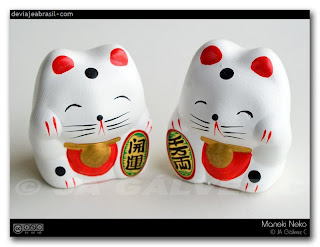
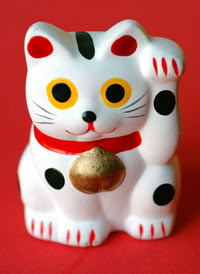
The Maneki Neko (招き猫, literally "Beckoning Cat"; also known as Welcoming Cat, Lucky Cat, Money Cat or Fortune Cat) is a common Japanese sculpture, often made of porcelain or ceramic, which is believed to bring good luck to the owner. The sculpture depicts a cat (traditionally a Japanese Bobtail) beckoning with an upright paw, and is usually displayed—many times at the entrance—in shops, restaurants, and other businesses. A raised right paw supposedly attracts money, while a raised left paw attracts customers.
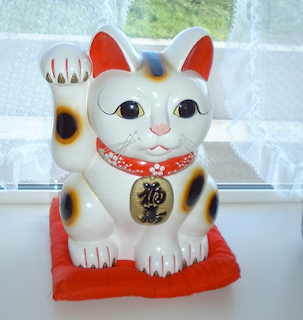
Maneki Neko come in different colors, styles, and degrees of ornateness. In addition to sculptures, Maneki Neko can be found as keychains, piggy banks, air fresheners, and miscellaneous ornaments.
- Maneki Neko come in all sorts of colors. While originally the colors may have been simply decorative, different colors are now associated with different attributes.
- Tricolor (Calico/Tortie and White): The background is white with random black and orange patches. This coloring is considered especially lucky and is the most popular color for maneki neko. This belief may be related to the rarity of this coloring in the Japanese bobtail cats, after which the Maneki Neko is modeled. Also note that in Japan the colour is called Mi-ke, meaning three-fur.
- White: White cats indicate purity and are the second most popular type.
- Black: Black Maneki Neko are believed to bring good health and keep away evil. These are especially popular with women as they are supposed to be particularly effective at keeping away stalkers. Like red, they can be associated with good health, but very occasionally.
- Red: Red is also a protective color, and is believed to keep away evil spirits and illness.
- Gold: Associated with wealth.
- Pink: While not a traditional color this color is popular now and is associated with love.
- Green: Believed to bring academic achievement.
Japanese legend holds that long ago an emperor was traveling on horseback when he spotted a small cat waving at him. After the emperor dismounted from his horse to get a closer look the horse was struck by lightning and killed. Subsequently, the emperor pronounced that cats in general should be respected as sacred animals and thus was born the legend of the beckoning Maneki Neko. This is just one of several popular tales regarding the origin of Japan’s most famous cat.
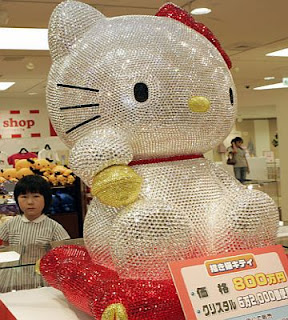
Today in Japan you are likely to spot a Maneki Neko figure waving at you from within just about every Japanese place of business. The legendary kitty has been transformed from an emperor saving Samaritan to a bringer of money and good fortune to all Japanese. There are basically three types of Maneki Neko: The first and oldest type is waving a single paw in an effort to attract people to it (just like the emperor’s savior). Another newer version (yet still likely centuries old) is a Maneki Neko waving one paw while holding an old fashioned Japanese coin in the other paw. This second type is thought to bring wealth to its owner. The final type of Maneki Neko is a modern version which waves both paws. Still further variations exist with additional meaning even ascribed to such things as the color and pattern of the coat. Maneki Neko are usually ceramic and are often used as piggy banks. Piggy bank Maneki Neko will have a slot in their back to receive coins and a hole in the bottom for their removal. Many modern Maneki Neko are purely decorative (no piggy bank) and may be made of papier-mache or cloth in addition to the traditional ceramic styles.
Labels:
Beckoning Cat,
Fortune Cat,
Lucky Cat,
Money Cat,
Nameki Neko,
Welcoming Cat
Japanese Superstitions

- The number four: The number four is considered inauspicious because it is pronounced the same as the word for death (shi). Therefore, one should not make presents that consist of four pieces, etc. In some hotels and hospitals the room number four is skipped. This superstition is, for obvious reasons, most commonly observed in hospitals. In a maternity ward, the number 43 would be a major faux-pas as it can be pronounced "shi-zan", which also means still-birth. While the number four is associated with death, the number nine is pronounced "ku", the same as the word for pain or suffering. So this number is also considered unlucky.
- Death of course means funerals, and traditional Buddhist funerals have certain rites and rituals. The night before the funeral itself, the dead body is laid out with the head facing north. So at home many people will not sleep this way, refreed to as "kita makura".
- One aspect of the funeral ceremony is to stick chopsticks into a bowl of rice placed on the altar. For this reason, people will never do this at the dinner table.
- Another example is that bone fragments of the cremated body are passed from person to person using chopsticks before being placed in an urn. Again for this reason, when eating people never pass food from one pair of chopsticks to another.
- If a funeral car passes you should hide your thumb.
- If you cut your nails at night, you will not be with your parents when they die.
- Lie down after eating: If you lie down immedeately after eating, you will become a cow.
- If you whistle in the night, a snake will come to you.
- There are also some imported superstitions such as the believe that black cats crossing the street in front of you cause bad luck.
- You'll get bad luck if you talk back to someone talking in their sleep.
- If your nose itches, someone that you know will have a baby.
- If you sneeze once, you're being spoken of well.
- If you sneeze twice, people are saying bad things about you.
- The third time, someone loves you, and, finally, the fourth time, you have a cold.
- If your ear itches, you'll hear good news.
- You will have bad luck if you break a comb, strap of gata, zori, or wooden shoe.
- You should always throw salt where a beggar has just been.
- If the first person you meet on any given day is a woman, you will have good luck.
- If it is a Buddhist priest, be prepared for a bad day.
- A good omen is getting a bird dropping on your head.
- If you are overtaken by a funeral procession on the street, you will have bad luck.
- Avoid badgers whenever possible, because they are evil and mischievous.
In many shrines, temples and souvenir shops, amulets are sold that are supposed to bring luck, safety or good fortune. There are amulets for money, health, love, success on exams, safety on the streets, etc. Small pieces of paper (omikuji) that predict your future are also available. These pieces of paper are tied around the branch of a tree after reading; either to make the good fortune come true or to avoid the predicted bad fortune.
- In taxis, there are always girl dolls, to keep away the female ghosts.
- Over the fireplace, there is a potholder charm in the shape of the kanji to keep the fire from spreading.
- Small charms with kanji on them keep away evil spirits.
- A material (paper or wood) wrapped in cloth brings you good luck if you keep it near you at all times.
Labels:
good luck charms,
Japanese superstititons,
omikuji
Sunday, February 17, 2008
Hina-matsuri

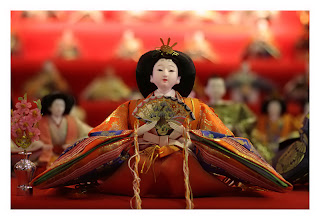
The Japanese Doll Festival (雛祭り), or Girls' Day, is held on March 3, the third day of the third month. Platforms with a red hi-mōsen are used to display a set of ornamental dolls representing the Emperor, Empress, attendants, and musicians in traditional court dress of the Heian period.
The top tier holds two dolls representing the Emperor and Empress. The dolls are usually placed in front of a miniature gold folding screen.
The second tier holds three court ladies. Each holds a sake-filler.The third tier holds five male musicians. Each holds a musical instrument except the singer, who holds a fan.
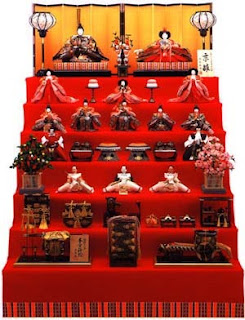
On the fourth, fifth, and lower tiers display a variety of miniature furniture, tools, carriages. Two ministers may be displayed on the fourth tier: the Right Minister and the Left Minister.
The custom of displaying dolls began during the Heian period. Formerly, people believed the dolls possessed the power to contain bad spirits. Hinamatsuri traces its origins to an ancient Japanese custom called hina-nagashi (lit. "doll floating"), in which straw hina dolls are set afloat on a boat and sent down a river to the sea, supposedly taking troubles or bad spirits with them.

Subscribe to:
Posts (Atom)