Wednesday, January 9, 2008

Yasaka Shrine


In 869 the mikoshi (portable shrines) of Gion Shrine were paraded through the streets of Kyoto to ward off an epidemic that had hit the city. This was the beginning of the Gion Matsuri, an annual festival which has become world famous.


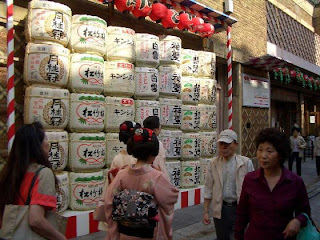
Today, in addition to hosting the Gion Matsuri, Yasaka Shrine welcomes thousands of people every New Year, for traditional Japanese New Year rituals and celebrations. In April, the crowds pass through the temple on their way to Maruyama Park, a popular hanami (cherry blossom viewing) site. Lanterns decorate the stage with the names of festival sponsors.


Gion Kouta
Maiko Miehina dances and Geiko Fumiyu plays shamisen while visiting Swinton Park during the 2006 festival of Japan.
Gion Kouta - A song made popular in the 1930 film "Gion kouta ehigasa". (The song was actually composed before 1930).
Gion District


This neighborhood in Kyoto has two hanamachi (geiko communities) : Gion Kobu (祇園甲部) and Gion Higashi (祇園東). Despite the considerable decline in the number of geisha in Gion in the last one hundred years, it is still famous for the preservation of forms of traditional architecture and entertainment.


Gion remains dotted with old-style Japanese houses called machiya, which roughly translated means "city house," some of which are ochaya or "tea house." These are traditional establishments where the patrons of Gion -- from the samurai of old to modern-day businessmen -- have been entertained by geiko in an exclusive manner for centuries.
Inside the ochaya is a private and closed world where the evening's entertainment may include cocktails, conversation, and games as well as traditional Japanese music, singing and dancing. To this day, geiko and maiko in full regalia can still be seen in the evenings as they move about through the streets of Gion to and from their various engagements at the ochaya.
There is a popular misconception that Gion was a red-light district. However, as it was a geisha district, and as geisha are entertainers, not prostitutes, Gion is not, and never was, a red-light district.
The geiko of Gion still maintain the annual dances, the most popular being the Miyako Odori, "Cherry Blossom Dances" or "Dances of the Old Capital," staged by the geisha of Gion Kobu. The dances run from April 1 through April 30 each year during the height of the cherry blossom (sakura) season. Spectators from Japan and worldwide attend the events, which range from "cheap" seats on tatami mats on the floor (approximately $15.00 U.S.), to reserved seats with a small tea ceremony beforehand (approximately $40.00 U.S.).
Monday, January 7, 2008
Pontochō Alley

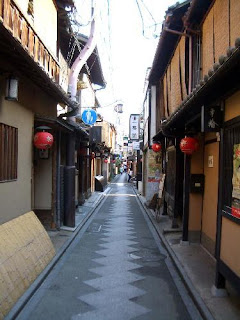
Geisha have existed in Pontochō since at least the 1500s, as have other forms of entertainment. Today the area, lit by traditional lanterns at night, contains a mix of very expensive restaurants—often featuring outdoor riverside dining on wooden patios—geisha houses and tea houses, and cheap eateries.

The area is also home to the Pontochō Kaburenjō Theatre at the Sanjo-dōri end of the street. This theatre functions as a practice hall for geisha and twice a year since the 1870s Kyoto geisha perform the Kamogawa Odori—Kamogawa river dancing, a combination of traditional dance, kabuki-like theatre, singing and the playing of traditional instruments—there, offering a rare chance for ordinary people to see performances by real geisha.
Nijo Castle


 Karamon Gate This Momoyama-period gate has a Chinese-style gable and gold-plated fixtures.
In 1601, Tokugawa Ieyasu, the founder of Tokugawa Shogunate, ordered all the feudal lords in Western Japan to contribute to the construction of the Nijō Castle. The construction was completed during the reign of Tokugawa Iemitsu in 1626. It was built as the Kyoto residence of the Tokugawa Shoguns.
The central keep or donjon was struck by lightning and burned to the ground in 1750.
In 1788 the Inner Palace was destroyed by a city-wide fire. The site remained empty until 1862.
 Entrance to Palace
The Nijō Castle has two concentric rings of fortifications, both consisting of a wall and a wide moat. There is also a much simpler wall surrounding the Ninomaru Palace. The outer wall has three gates while the inner wall has two. In the southwest corner of the inner wall the are the foundations of a five-storey keep, destroyed by a fire in 1750. The inner walls contain the Honmaru Palace with its garden. Between the two main rings of fortifications are located the Ninomaru Palace, Kitchens, Guard House and several gardens.
 The focus of Nijo Castle is the Ninomaru reception rooms, a staggered group of buildings interconnected by covered wooden walkways.
Ninomaru Palace
The 3300 square meter Ninomaru Palace is built almost entirely of Hinoki cypress. The decoration includes lavish quantities of gold leaf and elaborate wood carvings, intended to impress visitors with the power and wealth of the shoguns. The sliding doors and walls of each room are decorated with wall paintings by artists of the Kanō school.
The castle is an excellent example of social control manifested in architectural space. Low-ranking visitors were received in the outer, more gaudy regions of the Ninomaru, whereas high-ranking visitors were shown the more subtle inner chambers. Rather than attempt to conceal the entrances to the rooms for bodyguards (as was done in many castles), the Tokugawas chose to display them prominently. Thus, the construction lent itself to expressing intimidation and power to Edo-period visitors.
The building houses several different reception chambers, offices and the living quarters of the shogun, where only female attendants were allowed. One of the most striking features of Nijō Castle are the "nightingale floors" in the corridors. To protect the occupants from sneak attacks and assassins, the builders constructed the floors of the corridors in such a way as to squeak like birds when anyone walks on them.
Some of the rooms in the castle also contained special doors where the emperor's bodyguard could come out and protect him.

Honmaru Palace
The Honmaru Palace has a surface area of 1600 square meters. The complex has four parts: living quarters, reception and entertainment rooms, entrance halls and kitchen area. The different areas are connected by corridors and courtyards. The architectural style is late Edo period. The palace displays paintings by several famous masters, such as Kanō Eigaku.
The Honmaru Palace was originally known as the Katsura Palace before relocated to the present site and renamed. Originally the palace had 55 buildings, but only a small part was relocated.
