Stages of Training
Traditionally, they began their training at a very young age. Although some girls were sold to geisha houses (okiya) as children, this was not common practice in reputable districts. Daughters of geisha were often brought up as geisha themselves, usually as the successor (atotori, meaning heir) or daughter-role (musume-bun) to the okiya.
The first stage of training was called shikomi. When girls first arrived at the okiya, they would be put to work as maids, or do everything they are told. The work was difficult with the intent to "make" and "break" the new girls. The most junior shikomi of the house would have to wait late into the night for the senior geisha to return from engagements, sometimes as late as two or three in the morning. During this stage of training, the shikomi would go to classes at the hanamachi's geisha school. In modern times, this stage still exists, mostly to accustom the girls to the traditional dialect, traditions and dress of the karyūkai.

Once the recruit became proficient with the geisha arts, and passed a final, difficult dance exam, she would be promoted to the second stage of training:
minarai. Minarai are relieved from their housekeeping duties. The minarai stage focuses on training in the field. Although minarai attend ozashiki (banquets in which guests are attended by geisha), they do not participate at an advanced level. Their kimono, more elaborate than even a maiko's, are intended to do the talking for them. Minarai can be hired for parties, but are usually uninvited (yet welcomed) guests at parties that their onee-san ("onee-san" meaning "older sister", and is the Minarai's senior) attends. They charge 1/3 hanadai. Minarai generally work closely with a particular tea house (
minarai-jaya) learning from the "okaa-san" (proprietor of the house). These techniques are not taught in school, as skills such as conversation and gaming can only be absorbed through practice. This stage lasts only about a month or so.
After a short period of time, the third (and most famous) stage of training began, called maiko. Maiko are apprentice geisha, and this stage can last for years. Maiko learn from their senior geisha mentor and follow them around to all their engagements. The onee-san/imouto-san (junior) relationship is extremely important. Since the onee-san teaches her maiko everything about working in the hanamachi, her teaching is vital. She will teach her proper ways of serving tea, playing shamisen, and dancing, the casual talk of conversation, which is also important for a maiko to learn for future invitations to more teahouses and gatherings. The onee-san will even help pick the maiko's new professional name with kanji or symbols related to her own name. One would suggest that geisha are prone to "flirt," but it is only their nature to seem demure and innocent. Regional variations exist, as the han'gyoku of Tokyo are known for being sassy and the Kyoto maiko are known for being demure.
After a period as short as six months (in Tokyo) or as long as five years (in Kyoto), the maiko is promoted to a full-fledged geisha, and charges full price for her time. Geisha remain as such until they retire.
 Modern Geisha
Modern geisha still live in traditional geisha houses called okiya in areas called hanamachi (花街 "flower towns"), particularly during their apprenticeship. Many experienced geisha who are successful enough choose to live independently. The elegant, high-culture world that geisha are a part of is called karyūkai (花柳界 "the flower and willow world").

Young women who wish to become geisha now most often begin their training after completing junior high school or even high school or college, with many women beginning their careers in adulthood. Geisha still study traditional instruments like the shamisen, shakuhachi (bamboo flute), and drums, as well as traditional songs, Japanese traditional dance, tea ceremony, literature and poetry. By watching other geisha, and with the assistance of the owner of the geisha house, apprentices also become skilled in the complex traditions surrounding selecting and wearing kimono, and in dealing with clients.
Kyoto is considered by many to be where the geisha tradition is the strongest today, including Gion Kobu. The geisha in these districts are known as geiko. The Tokyo hanamachi of Shimbashi, Asakusa and Kagurazaka are also well known.

In modern Japan, geisha and maiko are now a rare sight outside hanamachi. In the 1920s there were over 80,000 geisha in Japan, but today there are far fewer. The exact number is unknown to outsiders, and is estimated to be from 1,000 to 2,000, mostly in the resort town of Atami. Most common are sightings of tourists who pay a fee to be dressed up as a maiko. A sluggish economy, declining interest in the traditional arts, the exclusive nature of the flower and willow world, and the expense of being entertained by geisha have all contributed to the tradition's decline.
Geisha are often hired to attend parties and gatherings, traditionally at tea houses (茶屋, ochaya) or at traditional Japanese restaurants (ryōtei). Their time is measured by the time it takes an incense stick to burn, and is called senkōdai (線香代, "incense stick fee") or gyokudai (玉代 "jewel fee"). In Kyoto the terms "ohana" (お花)and "hanadai" (花代), meaning "flower fees", are preferred. The customer makes arrangements through the geisha union office (検番 kenban), which keeps each geisha's schedule and makes her appointments both for entertaining and for training.
Makeup
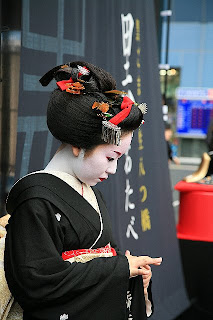
Today, the traditional make-up of the apprentice geisha is one of their most recognizable characteristics, though established geisha generally only wear full white face makeup characteristic of maiko during special performances.

The traditional makeup of an apprentice geisha features a thick white base with red lipstick and red and black accents around the eyes and eyebrows. Originally the white base mask was made with lead, but after the discovery that it poisoned the skin and caused terrible skin and back problems for the older geisha towards the end of the Meiji Era, it was replaced with rice powder.

The application of makeup is hard to perfect and is a time-consuming process. Makeup is applied before dressing to avoid dirtying the kimono. First, a wax or oil substance, called bintsuke-abura, is applied to the skin. Next, white powder is mixed with water into a paste and applied with a bamboo brush starting from the neck, up. The white makeup covers the face, neck, and chest, with two or three unwhitened areas (forming a "W" or "V" shape, usually a traditional "W" shape) left on the nape, to accentuate this traditionally erotic area, and a line of bare skin around the hairline, which creates the illusion of a mask.

After the foundation layer is applied, a sponge is patted all over the face, throat, chest, the nape and neck to remove excess moisture and to blend the foundation. Next the eyes and eyebrows are drawn in. Traditionally charcoal was used, but today modern cosmetics are used. The eyebrows and edges of the eyes are colored black with a thin charcoal; a maiko also applies red around her eyes.
The lips are filled in using a small brush. The color comes in a small stick, which is melted in water. Crystallized sugar is then added to give the lips lustre. Rarely will a geisha color in both lips fully in the Western style, as white creates optical illusions. The lower lip is colored in partially and the upper lip left white for maiko, and newly full-fledged geisha will color in only the top lip fully. Most geisha wear the top lip colored in fully or stylized, and the bottom lip in a curved stripe that does not follow the shape of the lip.

Maiko who are in their first stage of training will sometimes color their teeth black for a short period of time. This practice used to be common among many different classes of women in Japan, but survives only in some districts, or even families.
For the first three years, a maiko wears this heavy makeup almost constantly. During her initiation the maiko is helped with her makeup by either her onee-san or "older sister" (an experienced geisha who is her mentor) or by the okaa-san or "mother" of her geisha house. After this she applies the makeup herself.
After a maiko has been working for three years, she changes her make-up to a more subdued style. The reason for this is that she has now become mature, and the simpler style shows her own natural beauty. For formal occasions, the mature geisha will still apply white make-up. For geisha over thirty, the heavy white make-up is only worn during special dances which require her to wear make up for her part.
Hairstyles
The hairstyles of geisha have varied through history. In the past, it has been common for women to wear their hair down in some periods, but up in others. During the 17th century, women began putting all their hair up again, and it is during this time that the traditional shimada hairstyle, a type of traditional chignon worn by most established geisha, developed.
There are four major types of the shimada: the taka shimada, a high chignon usually worn by young, single women; the tsubushi shimada, a more flattened chignon generally worn by older women; the uiwata, a chignon that is usually bound up with a piece of colored cotton crepe; and a style that resembles a divided peach, which is worn only by maiko. This is sometimes called "Momoware," or "Split Peach." Additional hairstyles: Ofuku, Katsuyama, Yakko-shimada, and sakko. Maiko of Miyagawa-cho and Pontocho will wear an additional 6 hairstyle leading up to the sakko. Some include: Umemodoki, Osidori no Hina, Kikugasane, and Osafune.
These hairstyles are decorated with elaborate haircombs and hairpins (kanzashi).

In the seventeenth century and after the Meiji Restoration period, hair-combs were large and conspicuous, generally more ornate for higher-class women. Following the Meiji Restoration and into the modern era, smaller and less conspicuous hair-combs became more popular.
Geisha were trained to sleep with their necks on small supports (takamakura), instead of pillows, so they could keep their hairstyle perfect. To reinforce this habit, their mentors would pour rice around the base of the support. If the geisha's head rolled off the support while she slept, rice would stick to the pomade in her hair. The geisha would thus have to repeat the tiresome process of having her hair elaborately styled. Without this happening, a geisha will have her hair styled every week or so.
Many modern geisha use wigs in their professional lives, while maiko use their natural hair. However, either one must be regularly tended by highly skilled artisans. Traditional hairstyling is a slowly dying art. One reason for this is that the hairstyle over time, can cause balding on the top of the head.


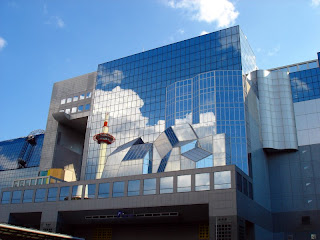 Kyoto Station


 Gion District, Kyoto